Meditations from the back door
Advent, obliquity, and the Sacro Monte di Varallo

We were an undeniably awkward trio. An art historian and two modern languages students, venturing hesitantly into the heart of the Piedmont, several hours north-west of Milan, in what was unseasonably hot weather even for Italy. An outside observer, if once acquainted with a few biographical details, may well have mistaken our little party for the opening of a bad joke – and a divine one at that – comprised as it was of an Anglican ex-Quaker, a Catholic ex-atheist, and myself, a contemplative charismatic Anglican, neither low nor high.
None of us really spoke Italian. And the Piedmont, home of the white truffle which grows in its luscious, forested hills, is one part of Italy where your phrasebook truly is your lifeline. We came armed instead with two bottles of Jungle Formula, two NIVs, and two copies of Julian of Norwich’s Revelations of Divine Love between the three of us. Thus equipped, we caught the number 50 bus from Vercelli to Varallo.
We were not on the trail of Italian culinary rarities, although the odd helping of black truffle pasta could not be resisted. We were there to follow in the footsteps of spiritual wayfarers, who have come on pilgrimage come to this site for hundreds of years. A loftier endeavour, perhaps. But one which, as would become clear, was nonetheless sensory, and offensively so. Offensive, less to the intellect, I have since reflected, than to that most delicate and particular of perceptive faculties: (good) taste. It is the generative power of attending to moments of distaste, and discomfort, which I have been pondering ever since.
Walking with Christ
The Piedmontese town of Varallo sits at the foot of the Sacro Monte di Varallo, or ‘holy mountain’, built to be Italy’s ‘New Jerusalem’ at the end of the fifteenth century. This alpine wooded hill would later be interspersed with 45 chapels, each housing tableaux, most notably those of Gaudenzio Ferrari, which depict the life and Passion of Christ through a mixture of immersive frescoes and over 800 terracotta statues. Founded in 1486 by Fra Bernadino Caimi, the Sacro Monte was designed as a replica of the Holy Land, reproducing much of its topography and landmarks. A notable example is the Scala Santa – the staircase Christ climbed before being sentenced to death – reproduced in shape and size. Now UNESCO World Heritage, this devotional site drew pilgrims from across Italy, allowing them to undertake an embodied journey through the scenes of Christ’s life, and the sites he walked. Statues were life-sized, inviting the pilgrim into a participatory involvement in the drama of the gospel, viewed through wooden screens with gaps at certain heights and angles. The site even functioned as an illustrated catechism during the Counter-Reformation. A curious choice of holiday for a definitely-not-Catholic.
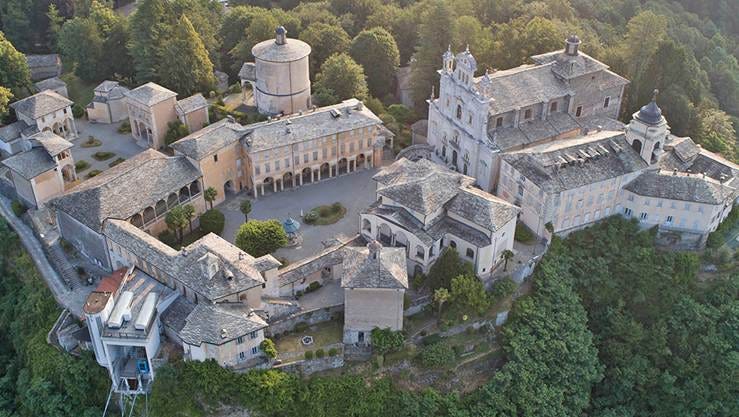
As my art historian friend explains, the Sacro Monte was a sort of ‘fifteenth-century theme park’, a Disneyland for lovers of such box office successes as The Annunciation and Ecce Homo. It was Counter-Reformation VR, with its lifelike materiality, including real (horse) hair and clothes, producing a sense of embodied reality and immanence, as if Jerusalem were actually present within the spatial confines of the Piedmont. Your whole body gets involved: kneeling, standing, walking, crawling to view the tableaux from the best angle. The project was undoubtedly animated by the same incarnational impulse that has already given us five seasons of The Chosen: the desire to ‘flesh out’ the life of Christ, to further ‘body it forth’ in our imaginations, so that we might know what it is to touch the hem of Christ’s garment, and feel ourselves touched in return.
As I write these words, several months after my Piedmontese travels, the Church is celebrating Advent – a season which, alongside death, judgement, and the end of all things, offers Christians the opportunity to meditate upon the mystery of the Incarnation. It is an opportunity we so often miss, distracted either by the commercial orgy we continue to insist on calling Christmas, or the sentimental homiletic mush served up in place of solid theological fare in so many churches. Even the most ‘evangelistic’ carol services sometimes seem to be impatient with the very event they are celebrating, accelerating past Bethlehem en route to Golgotha. Perhaps we should slow down and tarry a while with that most strange and disarming of ideas, so quick to pass our lips in this season’s songs, and yet so infinitely unfathomable. God incarnate. Infleshed. To a twenty-first century Protestant, the incarnational gravitas of the Sacro Monte may here prove devotionally productive. It might function for us as a kind of concretized Ignatian meditation, defamiliarizing a mystery which too often comes to us in the threadbare garb of festive platitudes.
Not where you thought you’d be
Engaging with the tableaux of the holy mountain is an embodied act. It produces physical discomfort, narrative disorientation, and a heightened awareness of your own positionality as a pilgrim. Very often the scene can only be properly appreciated by kneeling and peering through holes in the wooden screens. You feel fully involved, breaking bread at the last supper, or lost in the crowds on the via dolorosa. Sometimes a scene has to be built up holistically by gazing from several different angles, each ‘shot’ enabling a qualitatively distinct experience of its events.
I climb from the Nazarene section of the pilgrimage, which sits lower down the mountain, up an interminable flight of stairs towards Bethlehem. Passing by the wise men on the road, I duck my head under a low doorway to enter into what looks like a series of caves. This dark, squat interior turns out to be the Sacro Monte’s Nativity scene. Hidden behind stone and screen, I stumble upon it almost by accident when I stoop to peer through the nearest opening. Even then it takes a few seconds to register.
I have approached the stable from behind. I crane my neck over the heads of oxen, the bent backs of the shepherds, and the figure of Mary kneeling over something. They all obstruct my view. The focal point of the scene is hidden from me, no matter how much I contort my neck or strain my eyes. Somehow, I find this a more viscerally poignant experience than when I later turn the corner to peek through the side-view screen and at last behold the Christ child, apparently mid nappy-change. This now is familiar. This is every Christmas card and every church Nativity scene. Automatic response kicks in and the active part of my mind can switch off, as the faint scent of pine trees and mulled wine wafts my way. It lulls me with the reassurance, ‘nothing new here’, and I can relax into the armchair of the habitual.
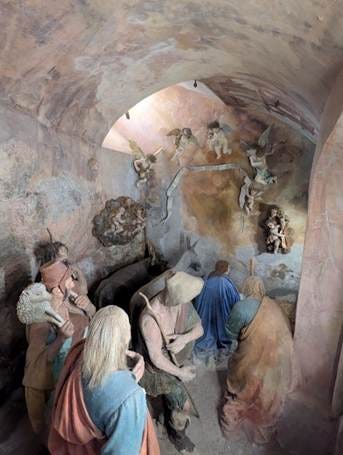
With their compelling 3D configuration and obstructive wooden screens, the chapels pull me away from an open-plan view of the Gospel story, away from the square-view gaze with its unlimited availability which on some kinaesthetic level I associate, rightly or wrongly, with my evangelical upbringing. I am here talking about the voice that says: it is all there, I have seen all, what more can I now see? It is that spirit of overfamiliarity which is the stumbling block of the contemplative.
The Sacro Monte instead ushers me into the stable via the backdoor. I must learn the art of patience, and of anticipation, as I strain past the others who so inconveniently insist on blocking my direct access to this God I have come to worship, and will not budge.
For the time that my vision is obstructed, I am left contemplating what is in front of me. And everywhere I am assailed by evidence of the sustained attention of others, all drawn to some centre just out of sight. Attention itself, etymologically, is a straining or tensing towards; it contracts, slackens and tires like a muscle. And here, kneeling on stone, my waxing and waning attention feels inescapably somatic. For a few minutes I experience, not primarily in my mind, but my body, the wonder of looking and not seeing, of being led to the manger throne by the loving attention of others, and not by some isolated impulse of devotion. I cease to strain, and I wonder at the Christ who, in this moment, I have not yet seen. At the Christ for whom I have waited, yet who seems to have momentarily withheld himself from me. In that very moment, he is instead showing himself in the sloped shoulders of others, whose faces I cannot see, but who are caught in reverence as they behold his glory.
The physicality of the Sacro Monte strengthens my grasp of what ‘approaching’ Christ might feel like, when I have bought into the illusion that it is somehow all there, available, propositional, a tap of the Bible app away. My phone screen, invisible for all intents and purposes, promises me an unmediated Christ, available on-demand, from the comfort of my ‘reality’. But God is not there, lurking somewhere in YouVersion, ready to peer back into the confines of my small perception of my own life. The wooden screens of the Piedmontese tableaux jolt me instead into the uncomfortable sense that I am not where I thought I was in the story. Each chapel is a concrete, spatialized Ignatian Meditation, only you find yourself in the stable, the courtroom, or the tomb, in a position to which you have not previously been accustomed. How humbling, to discover that you are in the crowd following our Lord, and not among the twelve. That while Christ walks the via dolorosa, you are playing with your dog in the dust of the road, not sufficiently entertained by his suffering. That you are gazing at the behind of a beast where you have always gone straight to the baby wrapped in swaddling bands. I call this a kind of grace: it is the blessedness of the perspective you have never felt you had permission to take.
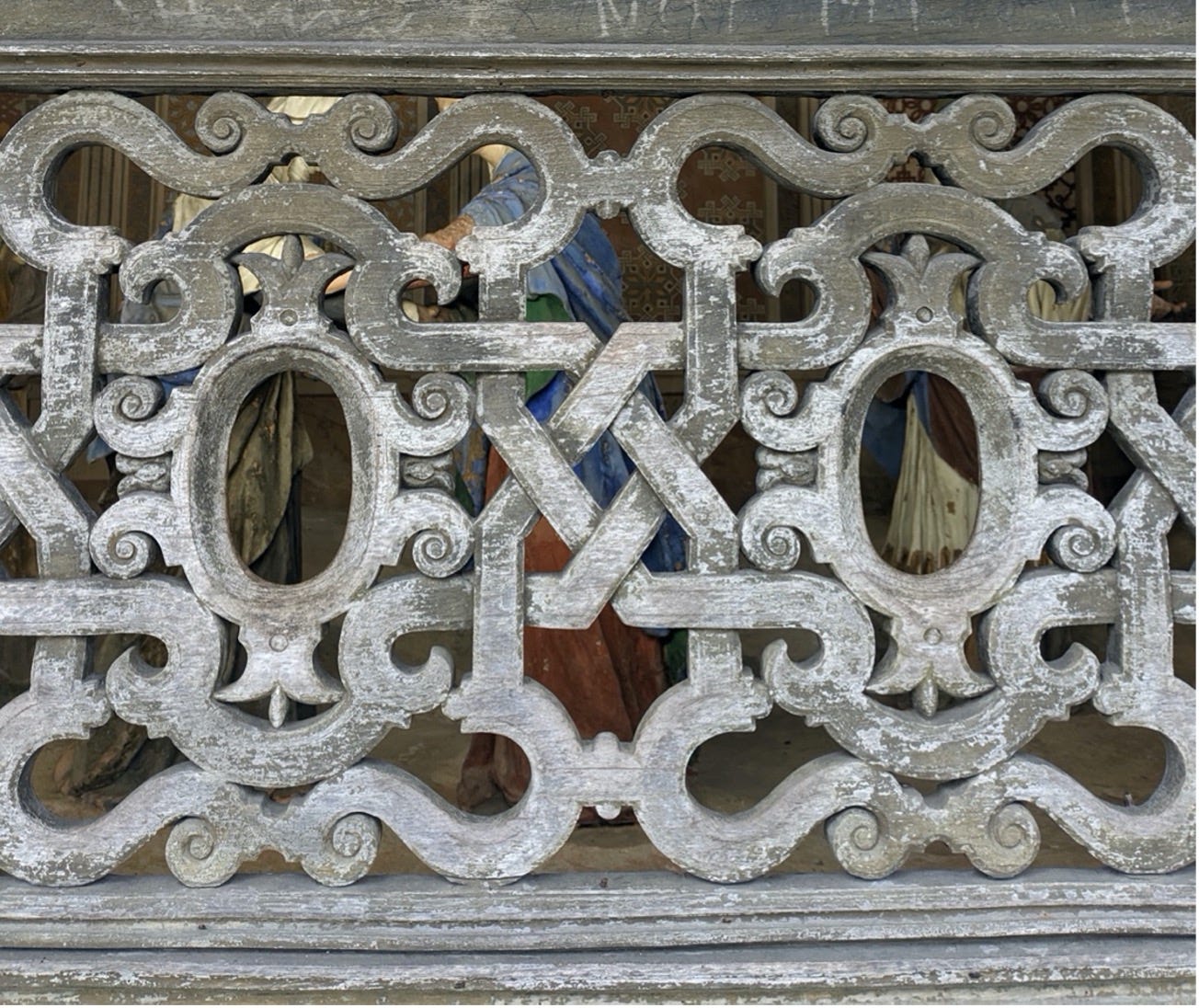
This Advent, I will not rush on ahead. I want to tarry a while at the stable’s backdoor, not despising the micro-attritions of niggling inconveniences and minor embarrassments which jostle for space with me in the stable, and which I dearly long to push away in favour of an immediate, unmediated encounter. Perhaps I can allow myself to be more hospitable towards these neighbour irritants. To take the unfamiliar position, behind the oxen and the lambs, if only to remember what it actually means to see. I will come to the Christ child slantways, drinking deep in oblong glances, taking the roundabout way.
Christ’s tacky flesh
The most uncomfortable thing about the Sacro Monte is how unflatteringly incarnational the whole experience is. On many levels, it is unpleasantly fleshy. As I walk the ancient paths of the Sacro Monte in the heat of the day, my body refuses to be bracketed off. I am thirsty, my mind is on the next espresso, lunch, the ache in my back, the insect bites on my ankles, the glare of the sun, yet another flight of steps, yet another kneeler. Following Christ, from the settlement in Nazareth, up the hill to Bethlehem, and all the way to Jerusalem, is tiring work. In fact, it’s exhausting, enough to make you grumpy, impatient, and sour-faced. I catch myself almost glaring at Jesus in the next chapel. No wonder the disciples kept stopping for snacks.
I reach the next chapel, and fittingly, it’s a tableau of Jesus and the woman at the well. My tongue is cleaving to the roof of my mouth. I want a drink. I begin to disengage; I am too physically drained for this spiritual experience I’m meant to be having.
And then it hits me. Pleased as man with man to dwell. This is the storied humanity which Jesus entered into – in all its inconvenient fleshiness. The tired, the bored, the hungry, the disengaged. I cannot ‘get past’ my bodily needs in order to encounter Him. Quite the reverse. There is a blessedness to bodily experience which, if we would only surrender it over to His grace, enlarges our capacity to receive the truths he would give us. I receive my bodily existence as a gift, enriching my imaginative frame of reference for the vibrant potential of the work of the Spirit in my inner being. How vexing it can be to admit that we are whole persons! That we do not come to God as disembodied consenting intellects. The promise of living water would signify little to an angel.
There is a disconcerting ickiness to the Sacro Monte. In the most material sense, I cannot escape His fleshiness, all mixed up with that of the disciples and the crowd. The terracotta statues are tacky and unglamorous. They are adorned with horsehair wigs and are draped in garishly coloured fabrics. No halo marks Jesus out from his companions – they are all equally clayish. In one chapel, Jesus’ wig has even slipped off, leaving an embarrassingly bald Saviour. It makes our Lord’s humanity seem not so much scandalous as unseemly, shabby, indecorous, even absurd. Such a thing, I want to protest, does not befit the King of Glory. Our Lord certainly had a knack for going about things in a roundabout way.
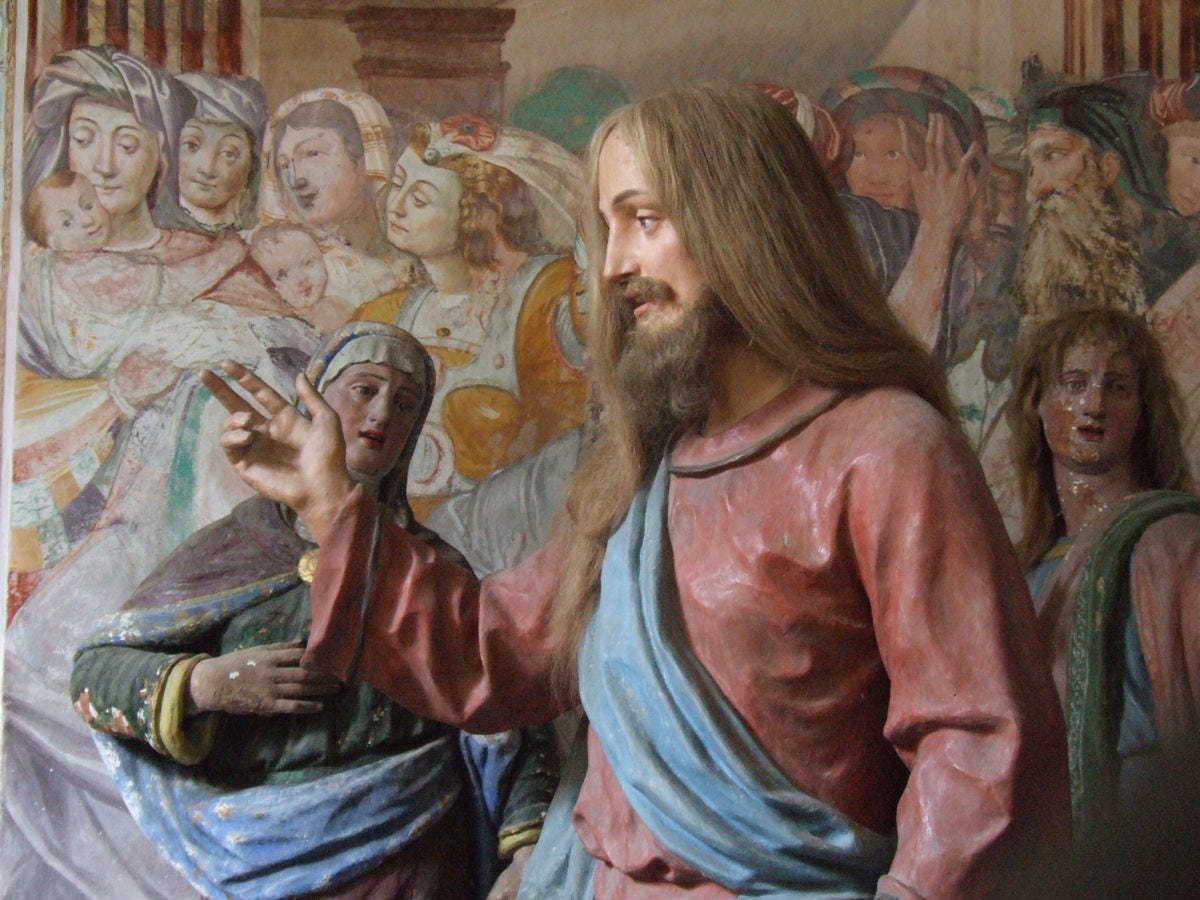
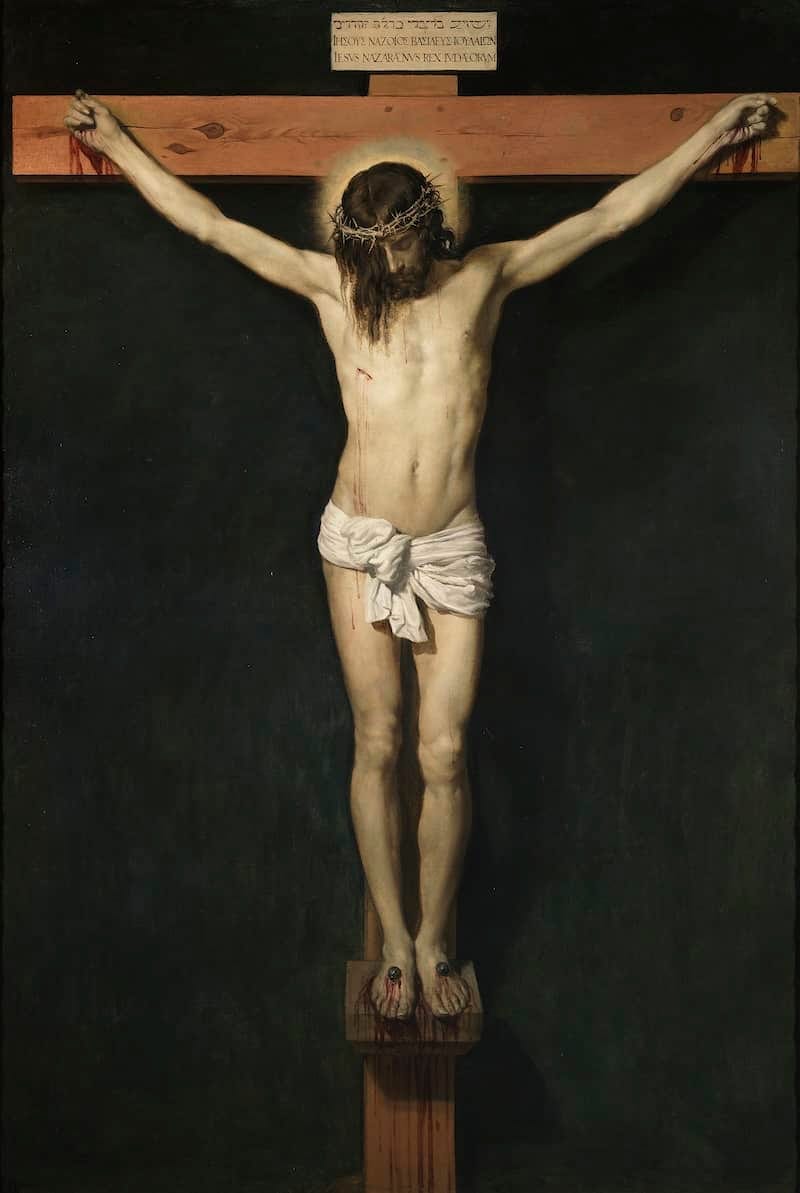
Jesus is not squeamish when he approaches us. I somehow doubt he would much mind that his wig had fallen off while he was busy casting out demons. My taste may prefer the grace and subtlety of Velazquez’s Christ Crucified, the poignant storytelling of a Duccio triptych, or the disarming angularity of El Greco’s Christs. Holy indeed do these works appear, and in their excellence is their offering. But there is also a grace in these icky clay statues. Christ will never shrink from touching me in my tacky humanity, if I would only receive him, and leave aside my objections about ‘bad taste’. He has entered this baked-earth life of mine, and made it beautiful. I may indeed long for my spiritual life to feel like a Velazquez, a Duccio, or an El Greco. More often than not, it has all the texture and quality of a Sacro Monte – of rough terracotta touch where I sought soft pigment. Glory be to the God who meets us in both.
This is beautiful…truly one of the best reflections I’ve read in a while, and one which poignantly captures that uncomfortable human side of prayer. Please keep writing friend! The world will be blessed if you do!